Does the Joint Clinical Assessment (JCA) hold a hidden lever for orphan drug pricing in Germany?
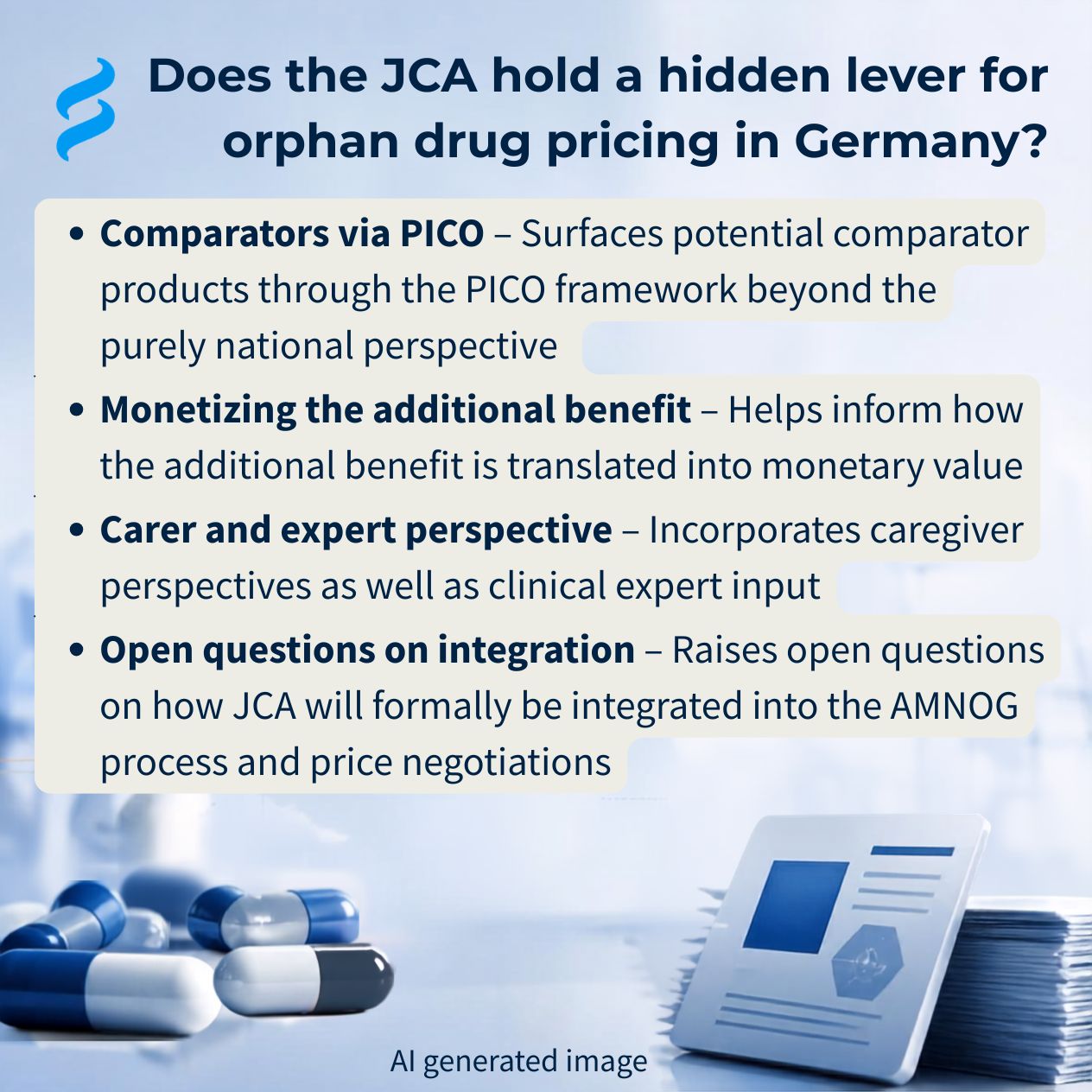
Does the Joint Clinical Assessment (JCA) hold a hidden lever for orphan drug pricing in Germany?
💊 In the German AMNOG process, the G-BA does not define an appropriate comparative therapy (ACT) for orphan drugs. As a result, negotiating parties often rely on analogue cases to approximate willingness to pay — not least because clinical trials frequently don't allow a direct comparison to standard of care.
Information from the JCA report might 👇:
🔹 Provide the GKV-SV with potential reference points for its pricing strategy
🔹 Introduce additional price benchmarks beyond the purely national perspective
🔹 Help inform how the additional benefit is translated into monetary value
🔹 Surface potential comparator products through the PICO framework
🔹 Incorporate patient/caregiver perspectives and clinical expert input
🔹 Support cost-saving arguments, for example where a favourable safety profile can be demonstrated
🔹 Introduce open questions around how it will formally be integrated into the AMNOG process and price negotiations
⚕️ As of August 10th, 2026, 10 of 19 ongoing or completed JCA procedures concern products with orphan drug designation.The first three completed JCAs, tovorafenib, lurbinectedin and tarlatamab, are all orphan medicines. Their corresponding German AMNOG procedures have now started. This makes these three products particularly interesting to watch. ⚕️
What reimbursement prices will ultimately be negotiated for these first JCA-based orphan medicines in Germany❓
And will the European evidence base create new reference points in the German price negotiations❓
At Ecker + Ecker, we will be closely monitoring these first cases and what they reveal about the evolving interplay between European clinical assessment and German benefit assessment, pricing and reimbursement.