Considering count data in HTA
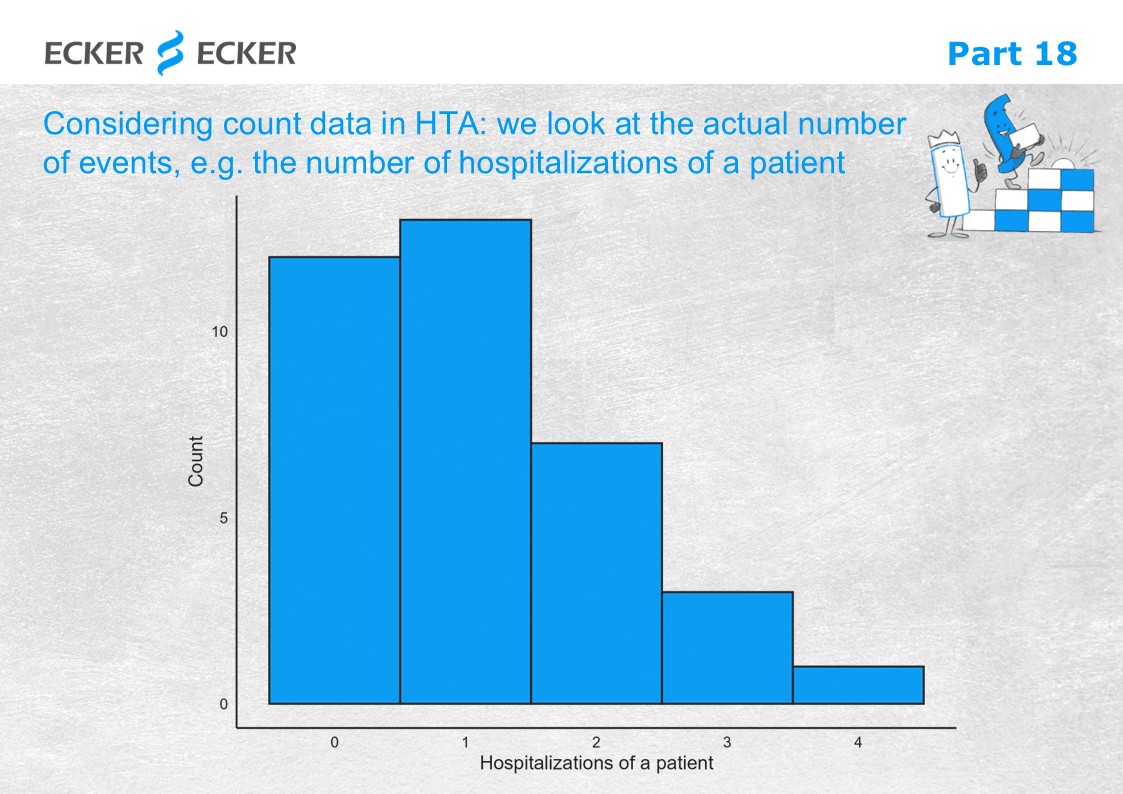
👀 Have a look on our statistical methods for count data!
🎓️ In HTA we sometimes encounter count data, e.g. the number of hospitalizations of a patient. While in a binary analysis we are only interested in whether a patient had a certain event or not, when considering count data we look at the actual number of events.
Statistical Methods:
📊 For analyzing count data we use regression. However, usual regression methods are not suitable. Hence, we use special regression methods for count data, which make assumptions about the distribution of the data. Typically, we use either the Poisson distribution or the negative binomial distribution.
📊 A common problem with count data is overdispersion. This means that the empirical variance of the data is higher than the theoretical variance of the used distribution. To test for overdispersion you can use the Cameron and Triverdi test. If you indeed detect overdispersion, you should use the negative binomial distribution.
📊 If you have a lot of zeros in your data, you should use a zero-inflated model. With the Excess Zeros Vuong test you can test if this is necessary.
📌 Be aware:
⚠️ If the length of the observation period differs between patients, the number of events is less meaningful. Instead, you should standardize the data using an offset variable. This gives you an event rate instead of the number of events.